Masonic Authority vs. State Authority
A Masonic charter or warrant is the grant of authority issued by a regular Grand Lodge to constitute a lodge, empower it to meet, and confer the degrees. That document creates lineage and is the basis on which other Grand Lodges judge regularity. By contrast, a state charter or registration [articles of incorporation, nonprofit registration, assumed name filing, or an IRS determination letter] creates only a civil legal entity so the body can own property, open bank accounts, sign contracts, and sue or be sued. Civil paperwork is good governance, but it does not create Masonic authority or regularity, and it does not prove lineage. Courts have noted this distinction in describing that a group operating “without a warrant or charter from any regular Masonic body” lacks the attributes of a legally existing Masonic organization in Masonic terms, even where it is incorporated under state law (Supreme Grand Lodge Modern Free& Accepted Colored Masons of the World v. Most Worshipful Prince Hall Grand Lodge of Georgia, 1954). Consistent with that boundary, in Bayliss v. Grand Lodge of Louisiana (1912), the Louisiana Supreme Court rejected a damages claim by an individual labeled a seller of spurious degrees, effectively distinguishing a Grand Lodge’s authority to identify and denounce degree-peddling as illegitimate.
How Lodges Are Lawfully Constituted in Masonry
In Anglo-American practice a lodge usually begins under a Grand Master’s dispensation, then receives a warrant of constitution from its Grand Lodge. Absent that warrant, the body is not legally established within Masonic law, regardless of what the Secretary of State or IRS acknowledges. The point appears explicitly in findings that “subordinate lodges can only come into existence, and cannot legally continue to exist except, by warrant or charter from a Grand Lodge. ”State incorporation or registration is about corporate governance and compliance, not Masonic status. Federal tax classifications such as 501(c)(8)[fraternal beneficiary societies] or 501(c)(10) [domestic fraternal societies]simply identify that an entity operates under a lodge system for tax purposes. Those classifications say nothing about whether a body is Masonically regular, and many non-Masonic or irregular groups also qualify for those codes (Internal Revenue Service, n.d.).
Standards for Lineage and Regularity
What establishes lineage and regularity is intra-Masonic, evaluated by other Grand Lodges against regular standards such as legitimacy of origin from a regular source, sovereign control over the Craft degrees within a defined territory, adherence to the landmarks in practice [belief in God, a Volume of Sacred Law on the altar, and no political or sectarian religious debate in tiled meetings], and reciprocal recognition relationships. Exclusive territorial jurisdiction, except by mutual consent, remains a central North American norm. Lineage is established when a lodge’s warrant comes from a Grand Lodge that itself had regular origin and maintains these principles. Recognition is a sovereign act by other Grand Lodges based on those criteria.
What Civil Courts Do and Do Not Decide
Civil courts generally avoid declaring who is Masonically “regular,” and they decide disputes under civil doctrines like unfair competition, fraud, corporate status, trademarks, and property. However, in rare cases courts have granted injunctions that, as a practical matter, determine which body may hold itself out to the public as the legitimate Masonic authority in a given context. In doing so, courts sometimes consider evidence of lineage, recognition, or even materials like Mackey’s Masonic Jurisprudence, yet they frame relief as a civil remedy rather than a theological ruling. Examples include federal and state decisions enjoining groups from holding themselves out as Freemasons or from using “Mason,” “Freemasonry,” “Free and Accepted Masons,” rituals, insignia, or similar identifiers where the record showed misrepresentation or operation without a warrant from a regular Masonic body. On the criminal side, Bergera v. United States (1924) affirmed mail-fraud convictions tied to the American Masonic Federation’s sale of “Masonic” degrees and false claims of regular standing, underscoring that bogus degree-peddling can be punished as fraud. At the federal civil level, the Fifth Circuit affirmed an injunction against the “Supreme Grand Lodge, Modern Free and Accepted Colored Masons of the World,” emphasizing unfair-competition remedies and the defendant’s lack of a warrant from a regular Masonic source, with the district-court opinion detailing findings on warrants and lineage and going as far as calling them "a colorable imitation" (Most Worshipful Prince Hall Grand Lodge of Georgia v. Supreme Grand Lodge, 1951; Supreme Grand Lodge… v. Most Worshipful Prince Hall Grand Lodge of Georgia, 1954). At the state level, Kentucky’s courts sustained injunctions against “International Free and Accepted Modern Masons” on unfair-competition principles saying they were misleading the public and priority of origin (International Free & Accepted Modern Masons, Inc. v. Most Worshipful Prince Hall Grand Lodge of Kentucky, 1958), while California’s Most Worshipful Hiram of Tyre Grand Lodge v. Sons of Light Grand Lodge (1949) limited overbroad relief but still approved injunctions against misrepresentation, noting that courts are not bound to apply Masonic law as such while calling both organizations clandestine in their findings. Corporate status can affect standing and title.
Working Definitions
A regular lodge is one chartered by a Grand Lodge with regular origin that maintains the regular principles and is in amity with other regular Grand Lodges. A clandestine lodge is any body that lacks a charter from a regular source or derives from an origin not considered regular, even if it is incorporated and compliant in every civil respect. Recognition is the decision by a Grand Lodge to treat another Grand Lodge as regular and in amity, which then permits intervisitation and Masonic intercourse among their lodges.
Practical Evaluation Checklist
In practice, evaluation is straightforward. First, ask to see the Masonic warrant and identify who issued it. If the claimed authority is a self-created “national congress,” a civil corporation, or a body that never had regular origin, the claim fails at the starting line. Second, confirm that the Grand Lodge exercises sovereign control over the Craft degrees within its territory and is not subordinated to non-Craft or external bodies. Third, verify that its lodges practice the regular standards, including belief in God, use of a Volume of Sacred Law, and the avoidance of political and sectarian religious debate in tiled meetings. Fourth, survey the landscape in the region, both among State Grand Lodges and Prince Hall jurisdictions, through published proceedings and recognition lists. Throughout, treat corporate filings, assumed-name certificates, and IRS letters as administrative paperwork only, not evidence of Masonic lineage.
Conclusion
Masonic authority, lineage, and regularity are established by warrants issued within the Masonic system and by adherence to regular principles. Civil charters and registrations make a lodge or Grand Lodge a lawful participant in the secular world, which is often prudent and sometimes necessary, but they neither confer nor cure Masonic irregularity. Courts may, on rare occasions, issue civil remedies that functionally resolve which organization may present itself as the legitimate Masonic authority to the public, but such orders remain civilized and do not substitute for recognition by other Grand Lodges.
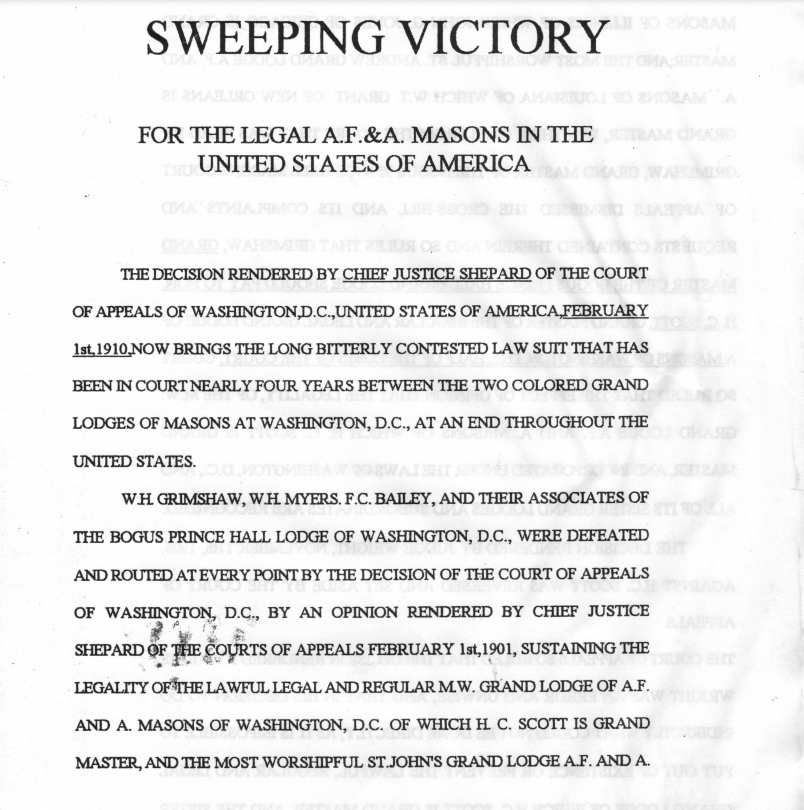
This court case is the pride and joy of all John G. Jones Affiliated organizations. If you look at almost of their websites they like to claim this court case as a reason why they are not a Bogus Masonic Organization. One big problem, they don't tell the story for what it is. They hold on to a document written by HC Scott and John G. Jones. Hopefully this helps clear things up.
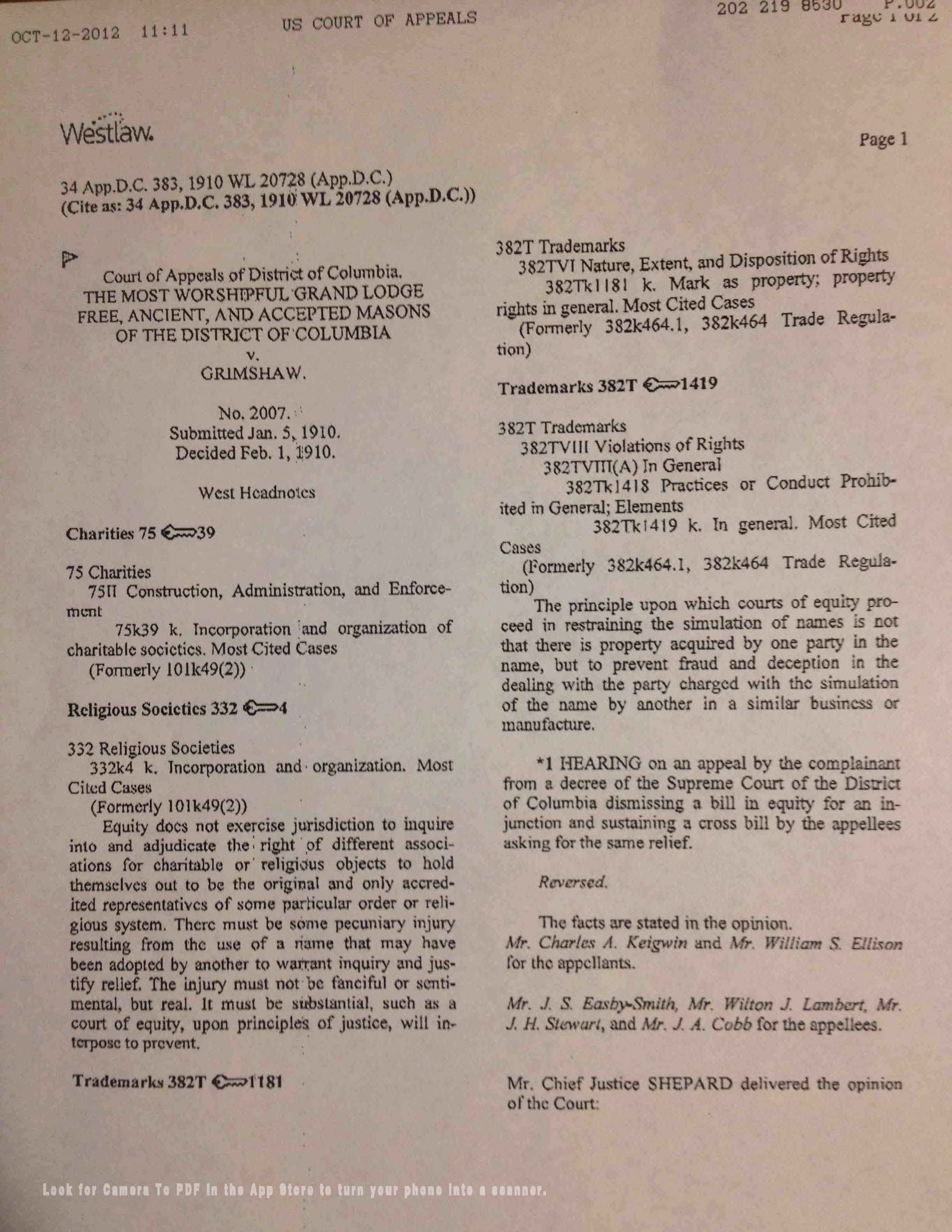
In the actual court case John G. Jones went under oath and said that the Romanian Charter was a lie created by Dorsey Seville. The original ruling of the case was in favor of William Grimshaw but HC Scott appealed and won the appeal. But why did he win?
Those in these Bogus masonic organizations will lead you to believe what was written in "Sweeping Victory" was true.
Problem was that this is not how things went down.
First, this isn't a legitimate court document and it was created to mislead clandestine masons into thinking they were legitimate. This document is 6 pages long and is completely different from what is in the actual Appeal.
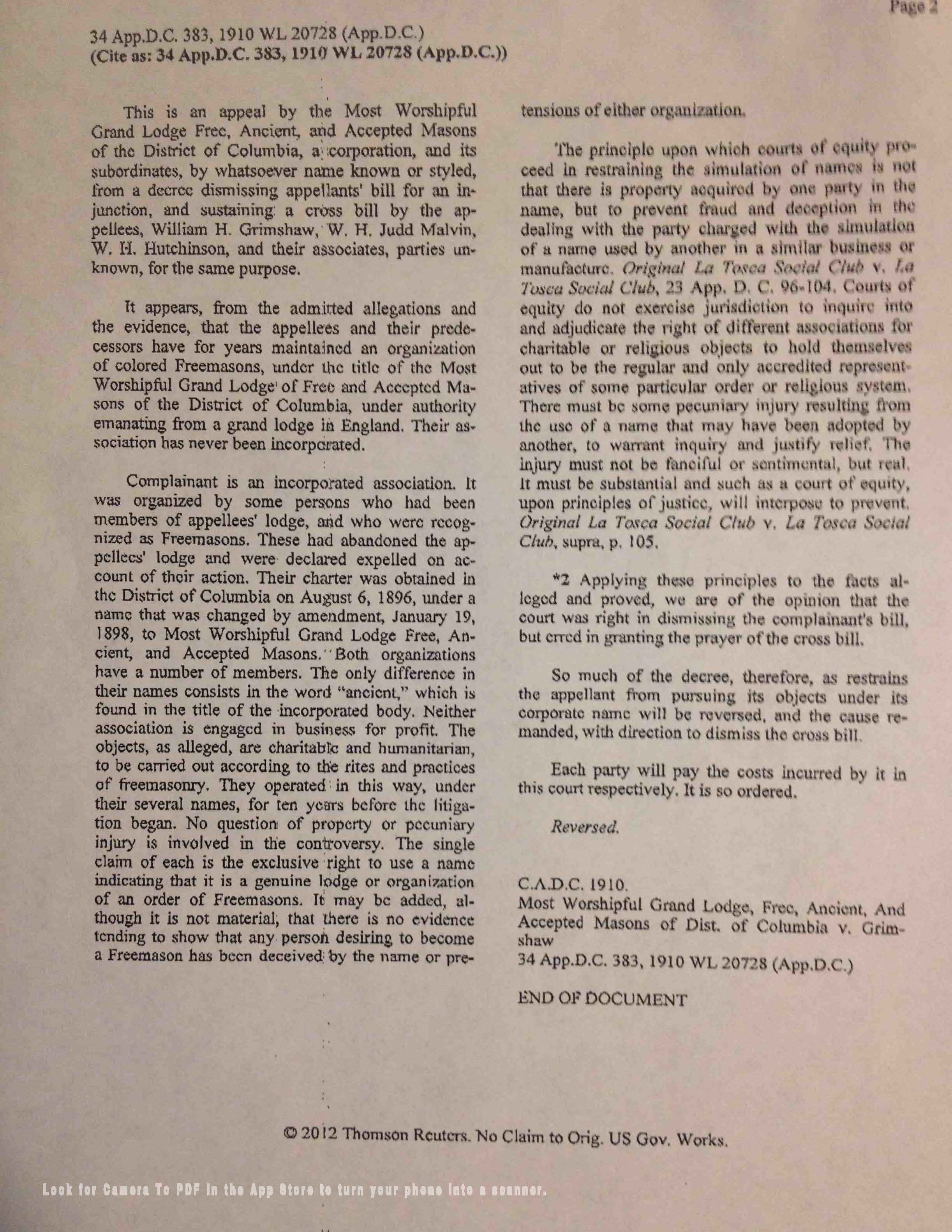
The actual appeal is number 2007 and can only be found with National Archives. On top of that is only 2 pages long. I have posted the legitimate court documents under this to debunk and false narratives created by John G. Jones.
Notice on Page 2 it clearly states "Complaint is an Incorporated association." This is important as it is clearly stating that they are using CIVIL law and not MASONIC Law. Civil Law does not determine masonic Law. Masonic Law was not a part of this court case. Anyone and everyone has a right to start and operate a business but a state charter can not determine if the business is a legitimate masonic organization. This is proven by what it says later in the document "Courts of equity do not exercise jurisdiction to inquire into and adjudicate the right of different associations for charitable or religious object to hold themselves out to be the regular and only accredited representative of some particular order or religion system."
In its first ruling, the court agreed that the National Grand Lodge was not descendant from the 1784 warrant.
"Upon the question as to whether or not in the year 1877 or 1878 the National Grand Lodge ceased to exist or adjourned sine die, there is a divergence in the evidence. However, this may be, it clearly appears from the weight of the evidence that there was a hiatus of eleven or twelve years in the operation and functioning of said National Grand Lodge."
The court also ruled that the National Grand Lodge failed to show by proper allegation of ultimate operative facts any proper title and lineage from the parent English organization to connect it with the warrant set forth and pleaded in the petition.
The National Grand Lodge kept going for appeals against this decision until 1921, the courts never reversed or modified the original ruling.
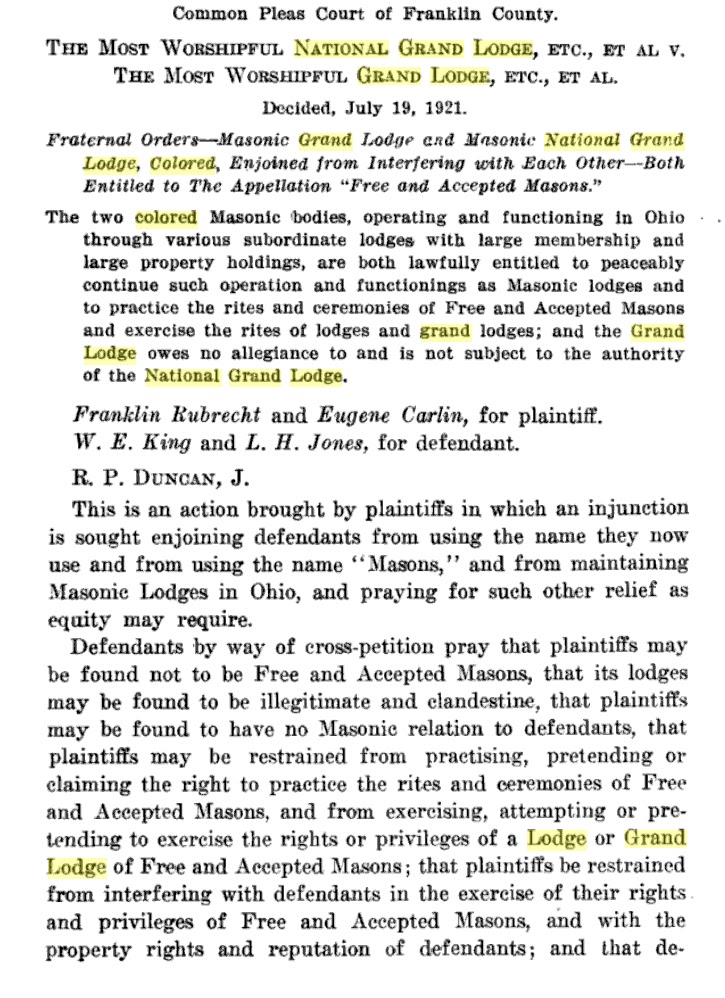
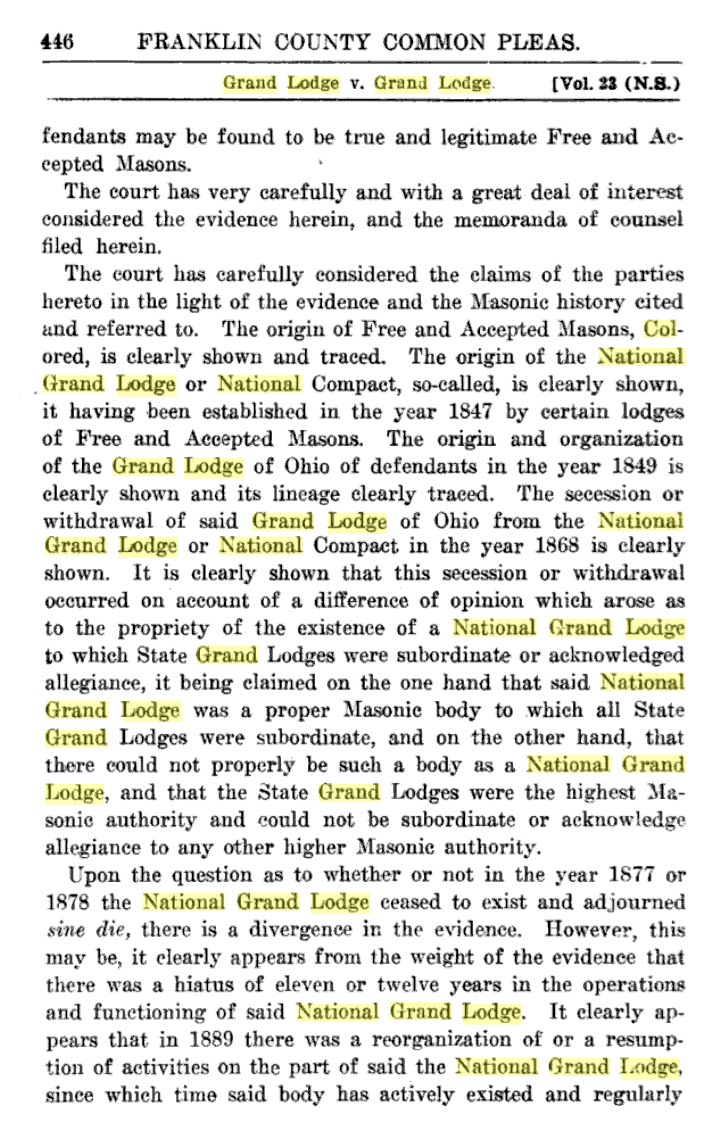
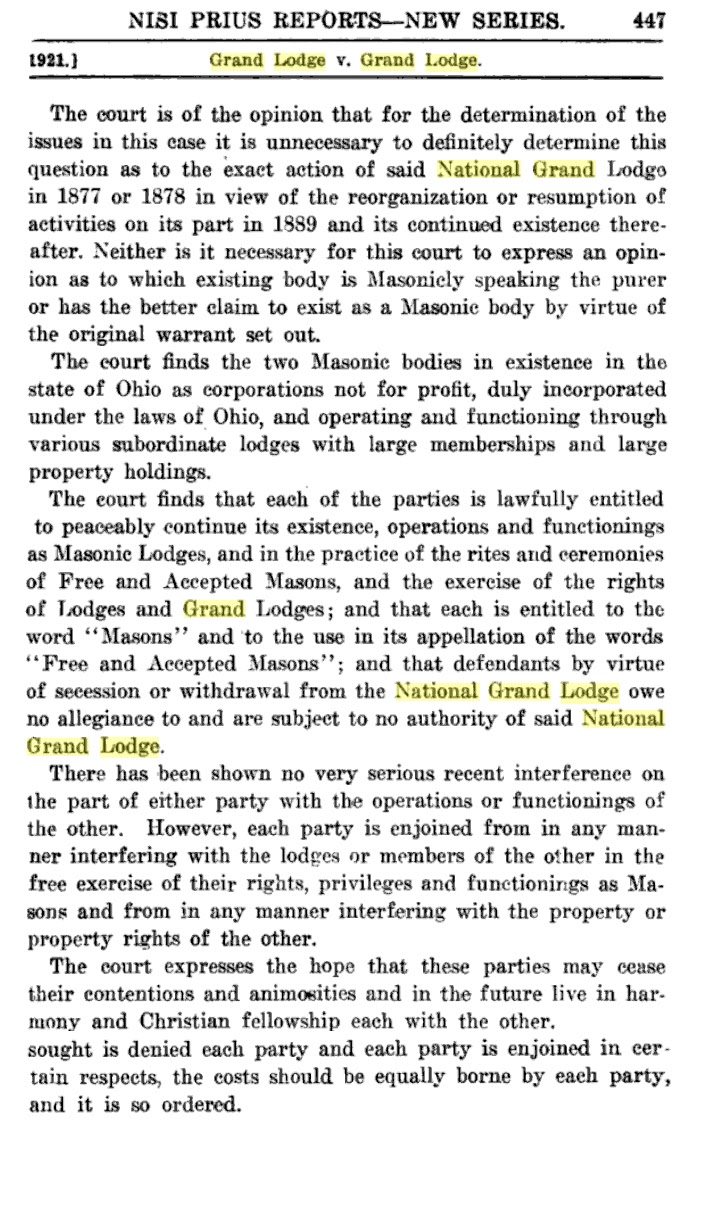
In this court case, Jerry Baxter Baldwin admitted under oath that his organization was clandestine.
"Petitioner made no attempt to prove that it had received any warrant or authority from any duly constituted Masonic group. In fact, the Grand Master of petitioner admitted lack of any such authority"
It was also proven that Modern Free only had a State Charter, not masonic
“I find that the defendant [Modern Free], or its legal predecessor, was granted a charter by a court of competent jurisdiction for the County of Jefferson and State of Alabama on November 17, 1921, …”
Courts also acknowledged that Modern Free was not a legitimate masonic organization
“I find that the defendant’s [Modern Free] use of the words "Free and Accepted" is an infringement on the real name or trade name of the plaintiff [Prince Hall] and is such a colorable imitation thereof that the general public, in the exercise of ordinary care, might think or be led to believe that it is the name of the plaintiff, who had the first and prior right to the use of the name. I find as a matter of fact that the use of the words "Free and Accepted" by the defendant [Modern Free] is a fraud against the plaintiff [Prince Hall], who is entitled to the use of those words, and that the dominant, controlling master mind of the defendant, J.B. Baldwin, intended to create the impression in the minds of the public that he and his group were the ancient and original "Free and Accepted" Masons, which they are not. I find that the adoption by the defendant of the words "Free and Accepted", which are the distinctive features of the plaintiff, was done by the defendant [Modern Free] with the intent to deceive and defraud the public and reap the benefits of plaintiff’s [Prince Hall] good will, to the injury and damage of the plaintiff [Prince Hall] , and to the confusion of the public. I find, according to masonic jurisprudence, that the defendant [Modern Free] was not regularly and lawfully organized, since it never had any charter, writ, or warrant of authority from any superior body.”
The court ruling said “I conclude that the defendant [Modern Free] should have a reasonable time within which to wind up its affairs in Georgia, or either merge with the York Masons, which appears to be a duly qualified and existing masonic body in Georgia and regularly and legally operated.”
Modern Free appealed in 1954 and the ruling was not overturned
to read more please go to :
The original court case found that King Solomon Grand Lodge was in violation of masonic law:
“The court finds that the defendant Grand Lodge in contravention of Masonic law, landmarks, usages, and customs, has set itself up as the Masonic Grand Lodge for the jurisdiction of New Mexico and that said defendant Grand Lodge is using the names, signs, insignia, symbols and distinctive phrases generally associated with Masonry."
In the appeal it was further explained that they purposely tried to deceive the public:
“We think appellant's use of the word "Mason" or the terms "Free and Accepted Masons" or "A.F. & A.M." or "F. & A.M.", renders the name of the Grand Lodges so strikingly similar, as to cause confusion, tends to deceive the public, and induces persons to join one institution when actually they intended to join the other. This is verified from what is later said. The quoted words and terms are distinctive features of appellee; indeed, they are its most valuable assets.”
The original ruling is affirmed, and King Solomon Grand Lodge was ordered to disband and merge into the Prince Hall Grand Lodge of New Mexico
For more information please read
https://law.justia.com/cases/new-mexico/supreme-court/1957/6143-0.html
In this court case William Banks lied about the formation of his organization.
“William Banks…deposed that his organization was in existence long before Prince Hall Lodge was organized in Kentucky or any other state; that International had its origin in England in 1716, …No authority is given to sustain this broad statement,....”
Banks also lied about being a mason
“Banks recited in his affidavit that he was initiated in St. John Masonic Lodge in 1925 in Geneva, Kentucky, (a hamlet in Henderson County) and his father had been initiated in the same lodge about the year 1901...He states his "lodge" at Geneva, Kentucky, "ceased to operate," but does not give the date. There is nothing in the record to show any connection of this reported organization andthe appellants.”
Then Banks admits being a member of Modern Free
“In 1939 Banks, …became the head of "Modern Free and Accepted Colored Masons" at the request of a man [Jerry Baxter Baldwin] who had been its head for 35 years.”
The courts found that International was purposely trying to deceive the public
“Banks, stated that by using the word "Modern" in connection with "Free and Accepted Masons," it has made "a special effort to make certain that prospective members understood that" it and the Prince Hall group of lodges were not the same organization. Nevertheless, it is affirmatively stated in affidavits of merit that International had used and employed rituals, insignia, etc. which are the same as those used by the appellants. It is further shown that affiants had been in fact misled into joining the appellants' lodges.”
for more information please read https://law.justia.com/cases/kentucky/court-of-appeals/1958/318-s-w-2d-46-0.html
Most Worshipful Prince Hall Grand Lodge of PA & United Supreme Council claimed
“It is further averred that: defendant, William J. Fitzpatrick, has falsely and fraudulently organized defendant bodies of Negro men in violation of the laws of Freemasonry and of the rights and exclusive jurisdiction of plaintiff Supreme Council, and has created Masonically spurious, clandestine and illegitimate associations for the purpose of defrauding plaintiffs and the public; … falsely and fraudulently represented to the public that defendant bodies have the right and authority to initiate Negro men as members of bodies alleged to be Masonic, as well as the right to confer Masonic degrees, …; defendant bodies and those associated with them have no authority to act as Freemasons nor to confer degrees of Freemasonry, and are spurious, clandestine and illegitimate, and have falsely and fraudulently adopted…”
The National Supreme Council then claimed
“defendant, William J. Fitzpatrick, …body is a direct descendant of and has had a continuous existence from the Supreme Council of the U. S. since 1864, and defendants have the right and authority to initiate members of the general public to legitimate and legally constituted bodies of Freemasonry in Pennsylvania and elsewhere and to confer degrees.” “Defendant…(National Supreme Council…) extending the life of the organization perpetually and designated "Re-Incorporation" was executed on September 11, 1948,filed in the Office of the Superintendent of Corporations for the District of Columbia on October 14, 1948."“Defendant William J. Fitzpatrick was formerly a member and officer of an authentic Prince Hall lodge, from which he was suspended. Subsequently, he became a member of a…subordinate body of plaintiff Supreme Council and was suspended therefrom in March 1928. Defendant William J. Fitzpatrick has never been restored to membership and is not a member of any Prince Hall lodge or any body lawfully affiliated with plaintiff organizations.”
The Court Rulings said “As evidence of the origin of defendant organizations we have only two documents. One is evidence of the incorporation of defendant Supreme Council in 1898, and the other of its "Re-Incorporation" in 1948…It is therefore clear that defendant Supreme Council was a self-constituted body, created without any authority or grant from any duly constituted Masonic organization.” “Defendants have no right to represent or identify themselves as belonging to or being associated with Freemasonry, or to use the names, badges, emblems, words, signs or symbols commonly known as identifying Masons and Masonic organizations.” “Defendants have wrongfully and unlawfully used and still use Masonic names, badges, emblems, words, signs, symbols and other Masonic identification, to the great damage and irreparable injury of plaintiffs.”
For more please read https://cite.case.law/pa-d-c2d/37/65/
In what is one of the most detailed masonic court cases involving a Prince Hall Grand Lodge the judge acknowledges masonic law:
“I find, according to Masonic jurisprudence, that defendants were not regularly and lawfully organized as Masonic bodies since they never had any charter, writ or warrant of authority from any authorized superior body.”
Furthermore, the judge also uses much of the same terms that regular masonry uses to define the bogus masonic organization:
“I find that defendants are not authentic masonic bodies; that they are — from a purely masonic point of view — spurious, clandestine and illegitimate and that they have no right to use the words "Free and Accepted" in their Masonic name nor in that of any of their so-called subordinate lodges or affiliates. Plaintiffs relied upon their common-law rights to protect their name as against defendants.”
Lastly in the ruling they were then told that they were to not consider themselves a masonic organization, separating the narrative that civil law equals masonic regularity.
“They may not, however, hold themselves forth as a Masonic organization. It is this virtual misrepresentation that an injunction will order discontinued.”
For more details go to:
https://case-law.vlex.com/vid/prince-hall-grand-lodge-885383242
M. W. Bayliss sued the Grand Lodge of Louisiana for defamation, claiming harm from two official circulars that labeled him a “clandestine pretender” and accused him of peddling spurious Scottish Rite degrees under the name of a Supreme Council of Sovereign Grand Inspectors General. He sought $40,000 in damages plus additional compensation.
The Louisiana Supreme Court affirmed the lower court’s dismissal in favor of the Grand Lodge. The Court held that the language used, terms like “bogus,” “spurious,” “clandestine pretender” and references to “degree-peddling”, were non-libelous, grounded in a privileged context of disciplinary communications within a fraternal organization. Additionally, Bayliss failed to allege special damages necessary for defamation under Louisiana law. This case affirms that Grand Lodges have the right to publicly denounce irregular or bogus Masonic bodies and individuals. They are legally protected when they issue such declarations in the course of internal discipline and regulation, as long as those communications are reasonable, privileged, and accompanied by the appropriate context. It underlines that claims of being a “regular” or “spurious” Mason are matters internal to Masonry, and courts defer to a Grand Lodge’s authority in these contexts.
For more information please go to:
https://case-law.vlex.com/vid/bayliss-v-grand-lodge-898339353?
This case brings up a famous clandestine vs clandestine court case in Most Worshipful Hiram of Tyree Grand Lodge of California vs Sons of Light Grand Lodge of California.
“Most Worshipful Hiram of Tyree Grand Lodge of Ancient Free& Accepted Masons (Colored) of State of California v. Most Worshipful Sons of Light Grand Lodge Ancient Free & Accepted Masons, Jurisdiction of California, 94 Cal. App. (2d) 25, 210 P. (2d) 34 (1949). In that case, both the plaintiff and defendant were found by the trial court to be clandestine Masonic lodges.”
to view this specific court case where is says "It is conceded and the court found that both plaintiff and defendant are ‘clandestine’ Masonic lodges." go to
https://caselaw.findlaw.com/ca-court-of-appeal/1796381.html
The Prince Hall Grand Lodge proved that these organizations were started by expelled masons and the bogus masonic organizations made a wild claim debunked in an earlier court case:
“Appellant John A. Bell Grand Lodge and appellant Universal Grand Lodge organized their grand lodges in the state of Washington in 1945 and1947, respectively. The former claimed to trace its Masonic ancestry to a lodge that was established by a former Prince Hall member who *34 was expelled by the Grand Lodge of Michigan in 1898, and the latter claimed ancestry to a white Grand Lodge of Romania.”
The courts then determined that these organizations are not legitimate masonic organizations:
“Appellants have, since their organization, falsely represented themselves as legitimate Masonic organizations and have sought and gained membership among colored men and women of good moral character who might otherwise have sought affiliation with respondents.”
The courts then go on to say that these organizations misled the public:
“The rituals, ceremonies, distinguishing names, words, insignia, symbols, emblems, badges, signs and paraphernalia used by appellants are identical, or so nearly identical, with those used by respondents as to confuse the identities of appellant organizations with those of respondents, and are calculated to confuse, mislead and deceive, and, in fact, have confused, misled, and deceived the public to the detriment and injury of respondents and of persons who may desire to become members of a legitimate lodge of Free and Accepted Masons or a legitimate auxiliary or associate group thereof.”
While there are much more details in this court case to be discussed the courts ruled that the appellants stop from founding or managing masonic lodges or affiliates.
“The trial court's decree enjoined appellants from establishing or conducting lodges of Masons or auxiliaries thereof within the state of Washington and from using the words "Ancient Free and Accepted Masons," "Free and Accepted Masons," "Masonic Lodge," "Masons," "Freemasons," "Scottish Rite Masons," of the initials "A.F. & A.M.," or "F. & A.M.," or any colorable imitations thereof in any manner whatsoever; and from holding themselves out as Masons or Masonic lodges and from using or employing rituals, ceremonies, names, insignia, emblems, badges, symbols, signs, paraphernalia, or designations of an organization of Masons.”
For more information please go to:
https://law.justia.com/cases/washington/supreme-court/1963/36081-1.html
The case involved a criminal prosecution for mail fraud. Dominic Bergera and associates, including Matthew McBlain Thomson, were part of the American Masonic Federation and its offshoot, the Confederated Supreme Councils. They were accused of using the U.S. mails to sell spurious Masonic degrees, claiming false authority from “Grand Councils” in Scotland in order to recruit members and collect fees across state lines.
Bergera, while not the chief architect, was convicted under the same mail fraud charges due to his active role in organizing and advancing the fraudulent scheme, specifically through issuing illegitimate charters and degrees while presenting themselves as regular Masonic authorities.
This ruling is a landmark enforcement action against “bogus” or clandestine Masonic operations. It demonstrates that civil authority will prosecute not only private individuals but institutional impostors who manipulate public trust by offering fabricated Masonic credentials. The prosecution and convictions underscore the reach of legal protections against fraudulent misuse of Masonic identity. The widespread use of deceptive claims of legitimacy, and the distribution of illegitimate degrees for profit, were deemed criminal, not Masonic disagreements but actual financial wrongdoing.
For more information please go to:
https://case-law.vlex.com/vid/bergera-v-united-states-894596087?
Copyright © 2021
Post Office Box 2212
Tacoma, WA 88999
President: Damajo Smith, FPS
Director: Joshua Feliciano, FPSH