“I denounce the bogus compact-colored Masons!” - John G. Jones, 1903
The term "General Grand Masonic Congress" (GGMC) has historically been entangled in controversy, disputes, and schisms, primarily tied to its founder, John G. Jones. In 1847, delegates from African American Grand Lodges formed the National Grand Lodge (also called the National Compact) to unify the jurisdictions. Jones, initially affiliated with Prince Hall Masonry, established his own organization known initially as the National Masonic Congress in (according to them) 1889, later renaming it the General Grand Masonic Congress of the U.S.A. & Canada (GGMC) in 1896. This is the first hole in their story, they have no evidence that it was formed in 1889 as both John G. Jones and HC Scott were Prince Hall Masons during this period.
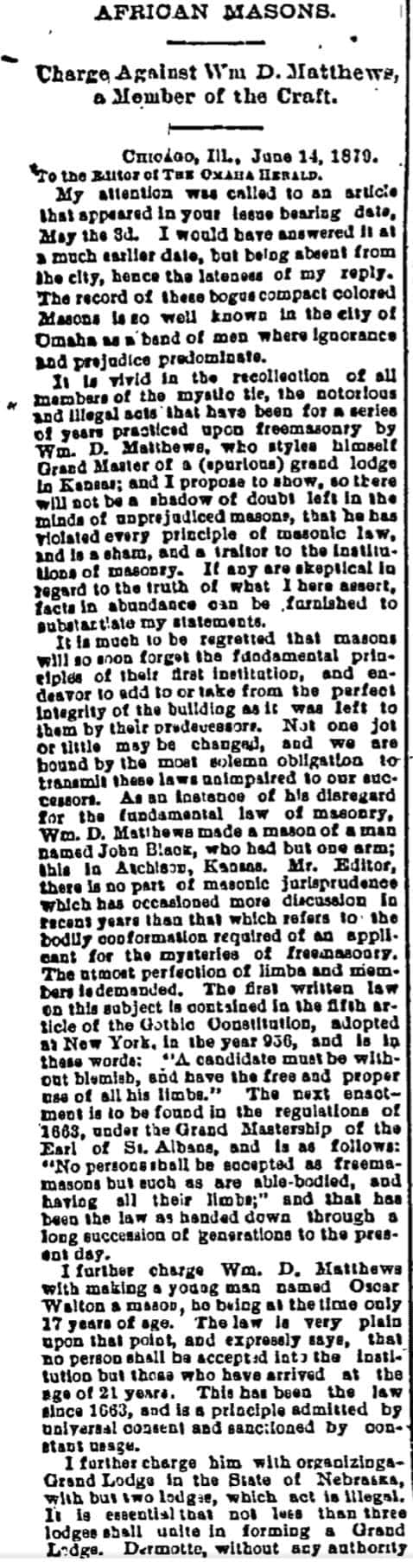
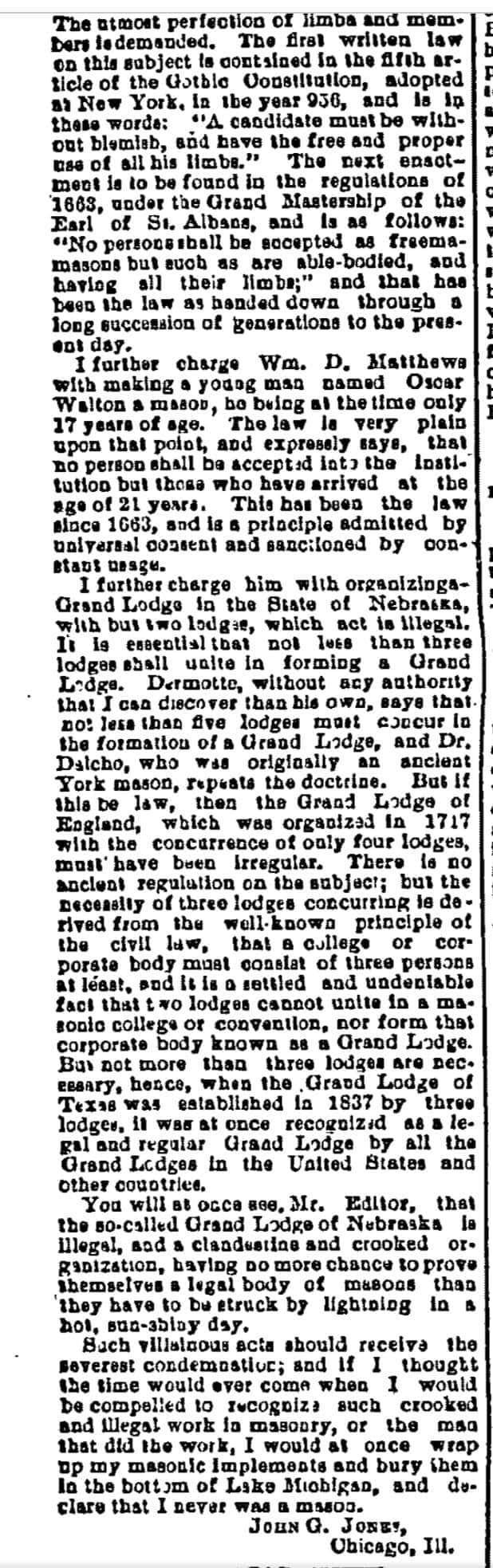
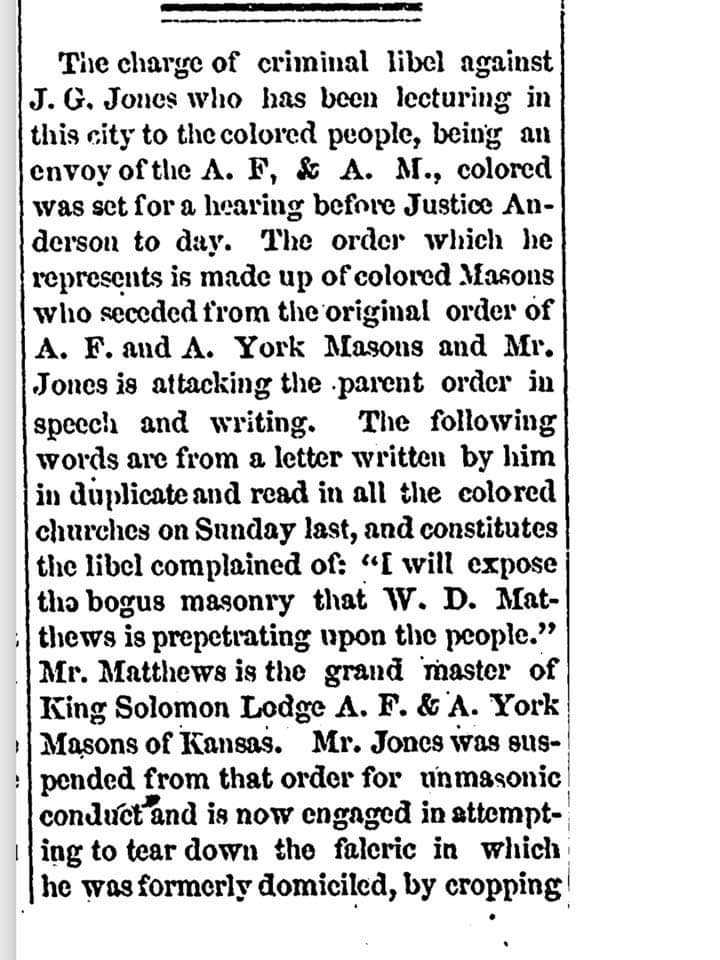
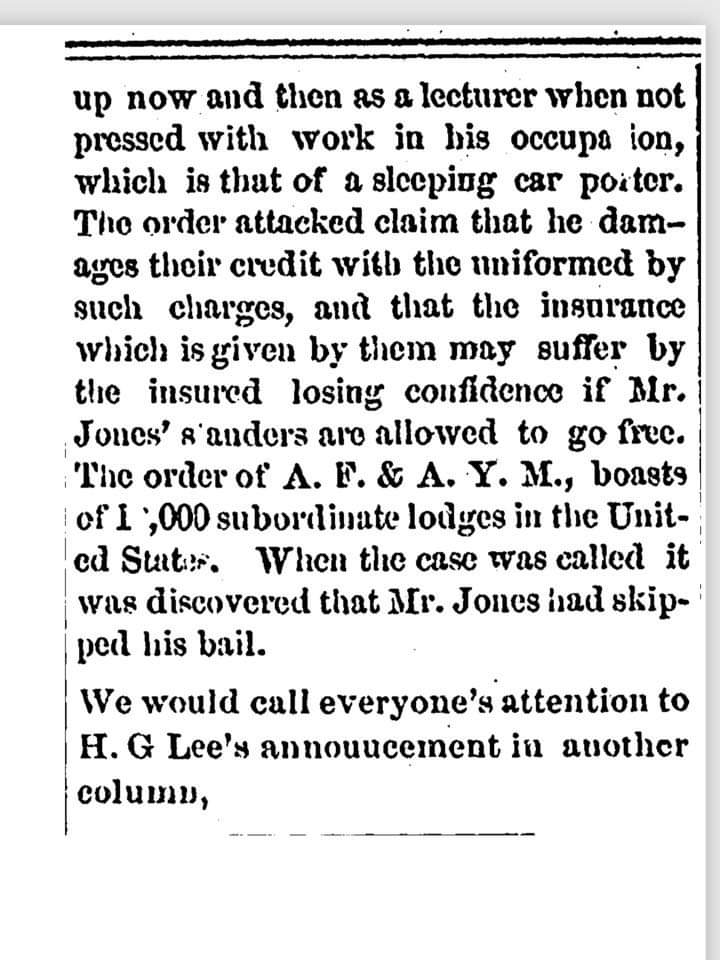
Jones's expulsion from Prince Hall Masonry was marked by severe disagreements, accusations, and ultimately his formal trial between 1903 for "unmasonic conduct" and clandestine activities. Documentation, including Jones’s own 1903 circular letter to Prince Hall Masons, and contemporaneous Chicago Defender coverage (11 Feb 1904, p. 3) provide compelling evidence of Jones’s contentious and adversarial stance against Prince Hall Masonry and the National Grand Lodge specifically.
Notably, Jones openly attacked William D. Matthews, declaring in his 1903 circular letter, “I denounce Matthews and his bogus compact brethren as pretended Masons unworthy of our ancient Craft,” a prominent leader associated with the National Grand Lodge, labeling him a "sham" and "traitor," and publicly condemning the National Grand Lodge itself as composed of "bogus compact-colored Masons." Jones also made serious allegations against Matthews, accusing him of violating fundamental Masonic principles by initiating underage and physically impaired candidates. These accusations were documented in widely circulated publications of the time and contributed significantly to the public discourse around Masonry among African American communities.
Given Jones’s evident hostility and the explicit accusations he levied, it is historically impossible for Jones's General Grand Masonic Congress to claim a legitimate lineage from the original National Grand Lodge established in 1847. Despite clear historical evidence to the contrary, subsequent GGMC affiliated bodies persistently assert direct continuity and legitimacy derived from the original National Grand Lodge.
The Romanian Charter Myth
To validate the General Grand Masonic Congress as a legitimate Masonic authority, John G. Jones and his ally H.C. Scott circulated claims beginning in 1896 that Jones had secured a charter from the Grand Lodge of Romania. This so-called Romanian Charter was promoted in flyers and correspondence by Jones’s circle, including Dorsey F. Seville, an expelled Mason from Washington, D.C. The intent was clear: to give an international appearance of legitimacy to a body that had been widely rejected by regular Prince Hall Grand Lodges.
However, there is no surviving evidence that any such charter was ever issued. No Grand Lodge of Romania has ever confirmed issuing a warrant to Jones or to any Prince Hall-related organization, and there are no official records in either Masonic or diplomatic channels. In fact, the first Romanian diplomatic presence in the United States did not occur until 1918, more than two decades after Jones claimed the charter existed and four years after he passed.
The Romanian claim was definitively exposed in 1910 during litigation between H.C. Scott’s faction and the Most Worshipful Prince Hall Grand Lodge of the District of Columbia. Under oath, Jones admitted that the Romanian charter was a fabrication originally concocted by Dorsey Seville. This admission undermined any lingering belief in the international legitimacy of the GGMC and became one of the most damaging disclosures regarding Jones’s Masonic credibility.
In later years, the General Grand Masonic Congress sought validation by affiliating with irregular Romanian factions. Notably, the GGMC publicized a "Treaty of Friendship" dated October 1, 2014, with a body styled "Universal Freemasonry (accepts women) – National Grand Lodge of Romania," led by George Ivașcu. This group is separate from the recognized National Grand Lodge of Romania (founded in 1880 and reorganized in 1993), the only Romanian lodge universally recognized by the United Grand Lodge of England and mainstream Freemasonry worldwide. The bogus "Universal Freemasonry – National Grand Lodge of Romania" has been active at least since 2014, with leadership under George Ivașcu acknowledged publicly by 2021. Additionally, another bogus Romanian faction calling itself "National Grand Lodge Romania 1880" emerged around 2008–2011, founded by expelled Masons from another unrecognized Romanian body. In other words, they aren’t legitimate.
These modern affiliations with unrecognized Romanian factions do nothing to legitimize Jones’s original fraudulent claims. Rather, they reinforce a long-standing GGMC pattern of aligning with irregular entities, leveraging misleading documents and spurious claims to bolster their perceived legitimacy. This pattern of behavior underscores the fundamental issues of credibility and recognition that continue to define the General Grand Masonic Congress.
Throughout its history, the GGMC experienced repeated divisions, often stemming from leadership disputes, ideological differences, or financial conflicts. The major milestones can be tracked succinctly:
Years
Event
Outcome/Significance
1927 & 1946
Formal reincorporation’s in Washington, D.C. under Ill. G.C. Williams (1927) and Ill. J.C. Parker (1946).
Centralized the "Holy See" and codified the GGMC’s D.C. seat.
1954
Creation of the "Original General Grand Masonic Congress of Grand Masters, U.S.A. & Canada" (D.C. corporate registry filing, 4 May 1954).
The first major documented schism; competing national body.
2009
Formation of the "Original John G. Jones General Grand Masonic Congress of Grand Masters" (OJGJ‑GGMC).
Split by AR,NJ,PA,TX Grand Lodges dissatisfied with existing GGMC leadership.
2022
Emergence of the "Original General Grand Masonic Congress of Grand Masters of the United States, Inc." (OGGMC).
Further leadership rivalry, adopting “Original” branding.
2024 – 2025
SDCCE includes a "General Grand Masonic Congress" as one of its departments.
Demonstrates diffusion of the GGMC label into broader Masonic style federations.
If you haven't heard, splits in Freemasonry are unmasonic and you can't just form a masonic organization out of thin air because you don't get along.
Critically, none of these GGMC affiliated entities have obtained regularity in Freemasonry. Each operates independently, utilizing separate incorporations and governance structures while invoking John G. Jones's legacy to bolster perceived legitimacy despite lacking formal legitmacy.
Thus, contemporary usage of the term "General Grand Masonic Congress" often signifies claims of historical lineage rather than actual continuous existence. Jones’s explicitly documented animosity towards the National Grand Lodge makes any claims of direct succession or legitimacy untenable. Researchers should therefore approach all GGMC lineage claims with cautious scrutiny and demand primary documentation.
Given these complexities, researchers, historians, and members of the broader Masonic community must critically assess GGMC lineage claims. Reliance on verified historical documentation, legal evidence, and authoritative Masonic scholarship is essential to recognize that each modern GGMC organization represents a distinct, independently established entity rather than a single, continuous historical institution.
Copyright © 2021
Post Office Box 2212
Tacoma, WA 88999
President: Damajo Smith, FPS
Director: Joshua Feliciano, FPSH